

If you've spent time in Washington during the summer, you know the humidity can feel nearly as oppressive as in places much farther south. Fortunately, the worst of the season typically doesn’t last as long as it does closer to the steamy Gulf of Mexico.
As weather watchers, we tend to focus on dew point — a measure of how much moisture is in the air — to gauge just how uncomfortable it may feel.
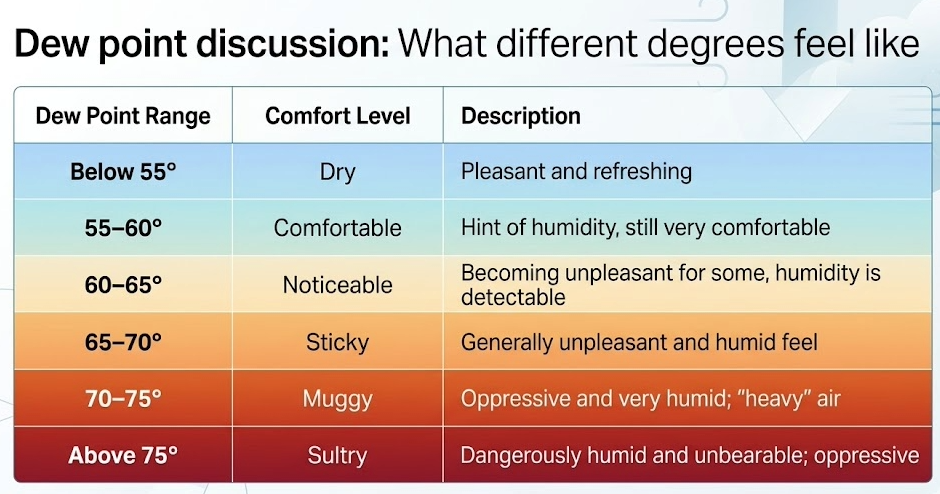
Once the dew point reaches around 60 degrees, you’ll likely begin to notice the humidity, especially during physical activity. At 65 degrees, conditions often start feeling sticky or unpleasant. When dew points reach 70 degrees, many people describe the air as downright gross. At 75 degrees or higher, the air becomes oppressive and can feel almost unbearable.
You may also hear about relative humidity, but on its own it’s usually a less useful measure of how the air feels than dew point, so meteorologists mention it less often. One notable exception is 100 percent relative humidity, which almost always occurs when it’s raining or foggy.
How often humid dew points occur during the year in Washington
How often humid dew points occur during the year in Washington
The most reliable season for noticeable humidity in the D.C. area runs from roughly mid-May through mid-October. Humid air can occur outside that window, but it’s less common. July typically marks the peak of humidity season, though August can also be oppressive while sometimes offering the first hints of fall.
In most years, the highest dew point reaches between 77 and 78 degrees. Dew points of 80 degrees or higher have occurred on several occasions. Most recently, that threshold was reached in August 2017, when dew points exceeded 80 degrees for several hours during the early afternoon. With temperatures near 90 degrees, the heat index climbed as high as 108 degrees.
Maximum dew point by year
The highest observed dew point in D.C. in this sample was 85 degrees on July 21, 1981. The reading occurred after rainfall and is sometimes viewed with caution because of its extreme value. With a temperature of 88 degrees, the combination produced a heat index of 114 degrees.
More recently, an exceptionally high dew point of 83 degrees occurred overnight on July 2, 2012, around 1 a.m. Even at that hour, the air felt close to 100 degrees when humidity was factored in.
D.C.’s official observation site at Reagan National Airport sits just feet from the Potomac River. When river water is very warm and winds blow off the water, dew points there may run slightly higher than across much of the surrounding area.
Overall, D.C.’s highest annual dew points have remained relatively steady, fluctuating within a degree or two over recent decades.
Average dew point by month
At the other end of the scale, the humidity-free season typically runs from October through April, with the driest air arriving in midwinter. The least humid stretch of the year usually falls between mid-January and mid-February.
The lowest dew point observed in the 50-year sample examined here was minus 26 degrees on Jan. 17, 1982. Dew points have fallen below zero during every month from November through March.
Even in the cold season, however, brief surges of moisture can occur ahead of strong cold fronts or during mild weather patterns. Dew points have climbed into the mid-60s in January through March and the upper 60s in November and December.
Based on 50 years (1976-2025) of hourly weather observations from National Airport. Data from Iowa Environmental Mesonet.


